

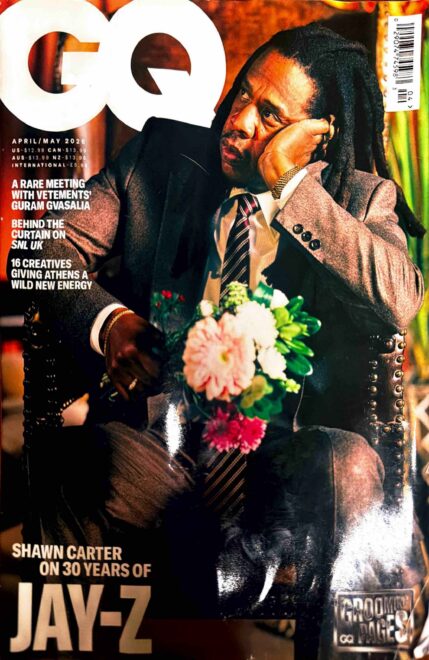
Charles Bo Bowen the entertainment lawyer in Savannah, Georgia is appealing his loss to me in Magistrate Court where he tried to evict me because I read a paragraph from GQ magazine that quoted JAY-Z, talking about his own songs. Above is a of picture exactly what I read. Sean Carter, aka JAY-Z is the greatest rap artist of all time -- in my opinion. I’ve named two dogs after him -- Hova and Hova II. My best friends are black.
Bowen and his lawyer Maston is as good a lawyer as Bowen is at making a contract.
Here is a link to Charles Bo Bowen's pdf Judgment of his total loss to me Jason Cerbone: https://savannahduilawyer.com/wp-content/uploads/2026/07/2026-06-01-Judgment-Jason-Cerbone-wins-against-Bo-Bowen.pdf
Bo Bowen is a liar and a thief
Bo Bowen is as liar. Bo Bowen told my father, Adam Cerbone that if I won his eviction lawsuit that he would have no problem with me staying and finishing my 3 year lease. First, that means his current legal action is a frivilous.
Bo Bowen is a thief. A judge hand delivered two signs to my office to the Receptionist, (the woman who Bo brought his eviction suit for.) I never got those signs. Bo Bowen stole my property. Therefore he is a thief.
@JAYZclassicBarxx
JUDGMENT
The above-styled case having been scheduled for a hearing on May 26, 2026, and having heard and considered evidence presented; and having considered the
pleadings, testimony, evidence presented, and applicable law, the Court issues the following findings and conclusions.
FINDINGS OF FACT
- Defendant is a tenant residing at premises pursuant to a written lease agreement with Plaintiff.
- The lease agreement provides, in relevant part, that the landlord may terminate the lease for "engaging in activities that create a nuisance, disturb tenants or subtenants, and/or negatively affect the reputation of the Parties in the discretion of the Landlord."
- Plaintiff's dispossessory action arises from a single incident occurring after business hours in a common reception area available to parties.
- During that incident, Defendant read aloud from a published news article concerning a rap artist interview discussing songs containing racial slurs,including titles and quotations incorporating the word " N-gga", which at least one of Plaintiff's employees said was pronounced "n***er".
- The evidence presented did not establish Defendant specifically used any racial epithet specifically toward any tenant, employee, or other individual present on the premises but read from an article quoting the song title from a well-known singer nor did the evidence show the Plaintiff's employee voiced any objection to Defendant at the time of the interaction. However, Plaintiff's employee didm indicate that she was initially shocked and did not want to confront the matter at the time, but very shortly afterwards notified her employer that she was gravely offended by Defendant's behavior.
- At the time of the trial, the evidence did not show any threats, intimidation, repeated harassment, physical misconduct, or repeated disruptive or offensive conduct or language by Defendant.
- Although Plaintiff's employee testified that she felt humiliated and uncomfortable working in the common area of her employer's workspace with Defendant, no evidence was presented establishing substantial interference with Plaintiff's or its employee's use and enjoyment of the premises, property damage, criminal conduct, or continuing nuisance activity.
- Both parties requested an award of attorney fees upon prevailing on the merits. Plaintiff presented evidence that they had incurred attorney's fees of $1690.15; however, Defendant did not present any evidence of attorney's fees.
CONCLUSIONS OF LAW
- Under O.C.G.A. § 44-7-50, a dispossessory proceeding may be maintained where a tenant holds possession beyond the term of the lease or otherwise violates lawful grounds for dispossession.
- The burden rests upon Plaintiff to establish by a preponderance of the evidence that Defendant materially violated the lease or otherwise created a legally sufficient nuisance warranting dispossession.
- Lease provisions granting discretionary authority to a landlord must nevertheless be exercised reasonably and in conformity with Georgia law and does not permit arbitrary or capricious enforcement. See Hunting Aircraft, Inc. v. Peachtree City AirportAuth., 281 Ga.App. 450,636 S.E.2d 139 (2006) ("[t]his implied duty requires both parties to a contract to perform their promises and provide such cooperation as is required for the other party's performance And, where the manner of performance is left more or less to the discretion of one of the parties to the contract, he is bound to the exercise of good faith. What constitutes good faith is a question for the finder of fact.). Forfeitures of leasehold interests are not favored in law and lease termination provisions are strictly construed against forfeiture where possible.
- The Court finds that the conduct at issue consisted of a single instance of reading aloud from published news content quoting song titles and statements made by a public figure.
- Although this Court certainly does not minimize the offensiveness of the language quoted nor the emotions felt by Plaintiff's employees, the evidence does not establish that Defendant used the language as a personal epithet directed toward any of Plaintiff's employees or any tenant.
- Georgia courts generally require substantial or material interference before conduct rises to the level of a legally actionable nuisance or lease-default warranting forfeiture of tenancy rights. See O.C.G.A. § 41-1-1 (defining nuisance as conduct causing hurt, inconvenience, or damage, where the inconvenience must not be fanciful or affecting only one of fastidious taste). However, it should be substantial. ( "Construction of the provisions of the lease, as with other contracts, is generally one for the court to determine as a matter of law." Longstreetv. Decker, 312 Ga. App. 1,3, (2011); see also Forsyth Cty. v. Waterscape Servs., LLC, 303 Ga. App. 623 (2010) ([a contract] breach is material when it is so substantial and fundamental as to defeat the object of the contract.)
- This Court has been unable to find Georgia law specifically applicable to a one time use of offensive language to another tenant; however, it notes that other courts found that where the offending conduct is an isolated incident which does not indicate a pattern of behavior, courts have been loath to impose the most severe sanction of a lease termination. See Jacobs v. Tuckahoe Housing Authority, 186 A. D. 3d 477, 129 N.Y.S.3d 498 (2020)(single threat of violence occurring in a heated telephone conversation failed to establish grounds to terminate lease although mentioning such conduct should not be tolerated, and if repeated, could warrant termination); London Leasing v. Borrero, 60 Misc.3d 1206, 109 N.Y.S.3d832 (2018) (Courts have generally held single incidents of objectionable conduct will likely be insufficient to establish nuisance). Again, the evidence showed a single instance of Defendant reading from a magazine containing a reference to a song title that contained the word "N-gga", although Plaintiff's employee indicated Defendant had been pronounced it as "n***er".
- The Court concludes that Plaintiff failed to establish that the isolated incident described herein materially disturbed tenants, constituted ongoing harassment, or substantially interfered with the use and enjoyment of the premises to justify forfeiture of the tenancy. However, by making this ruling based upon a single occurrence, this Court does not insinuate that this ruling should preclude a party from initiating any necessary action upon the occurrence of future conduct.
- Accordingly, Plaintiff has failed to meet its burden to establish lawful grounds for dispossession.
- Although Defendant has sought an award of attorney's fees, no evidence of any attorney fees was introduced at trial, and this Court cannot award damages to Defendant. IT IS HEREBY ORDERED AND ADJUDGED Plaintiffs dispossessory action is DENIED and Defendant's counterclaim is DENIED. All costs are assessed against the
Plaintiff(s).
So Ordered this June 1, 2026.